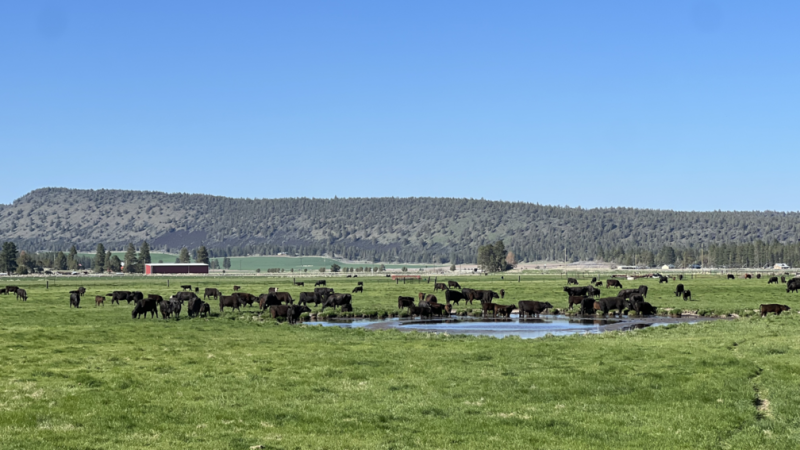
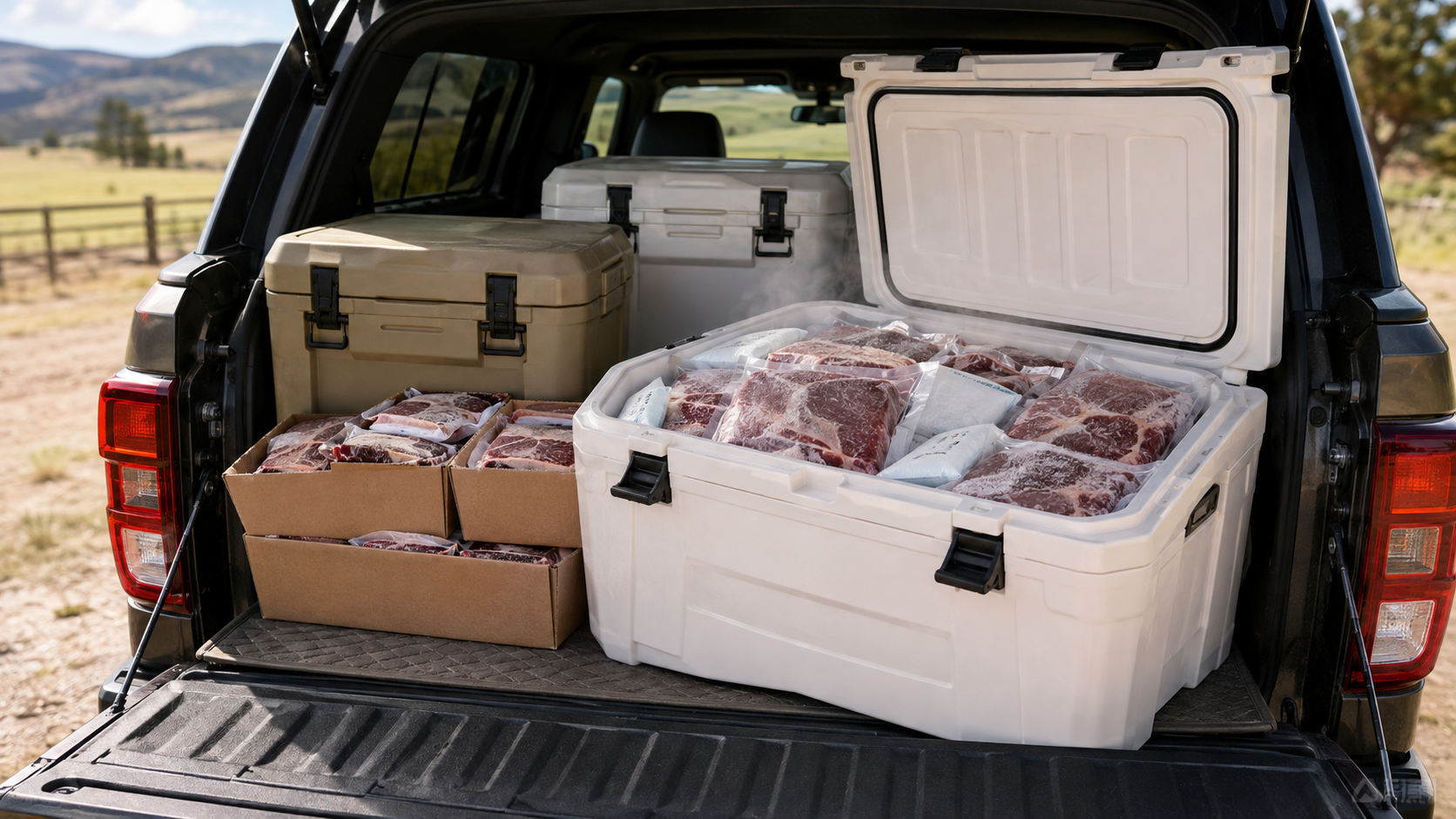
Your beef will be fine. Two hundred pounds of frozen, vacuum-sealed beef packed tightly and covered will hold on a three-hour drive without any real risk, even in August. The mass works in your favor. What causes problems isn’t the distance, it’s packing loose, leaving air gaps, and driving in the heat of the afternoon.
This is the question we get most often from first-time buyers in the Bay Area and Sacramento, usually a week or so before pickup. Here’s what to bring, how to load the car, and what to do if something softens on the way.
Will my beef be frozen when I pick it up?
Yes. Your beef is cut, vacuum sealed and frozen at the butcher before you collect it, so it comes to you rock hard and ready to go straight into your freezer. It’s not chilled or fresh. That matters for the drive, because a solidly frozen load behaves completely differently from a cooler of fresh meat.
Vacuum sealing helps too. There’s no air trapped against the meat, which means less surface to warm up and no freezer burn while it sits in your car.
Why 200 pounds of frozen beef is easier to move than 20
A big frozen load is its own ice block. Frozen beef has to absorb an enormous amount of heat just to get from freezer temperature up to thawing point, and far more again to actually start melting. The bigger and tighter the pile, the longer that takes.
The useful comparison is a power outage. A full freezer holds its temperature for roughly 48 hours with the door shut. A half-empty one manages about 24. Same principle in your car. More frozen mass slows warming. It’s why a single package left on the seat will soften long before the middle of a packed box gets anywhere near thawing.
So the goal on pickup day isn’t to keep 200 pounds cold. It’s to protect the outside layer, because those are the only packages actually exposed.
What to bring on pickup day
Less than people expect. You don’t need a refrigerated van or a stack of expensive coolers. You need insulation and a way to keep the load tight.
| What | Why it matters | Skip it if |
|---|---|---|
| Coolers | Insulates the outer packages, the only ones actually at risk | You’re bringing blankets and can pack tight |
| Moving blankets or sleeping bags | Cheaper than coolers and better at covering an irregular pile | Never. Bring these. |
| Cardboard boxes | Keeps the load stable and stops packages sliding into hot spots | The butcher already boxes your order |
| A few towels | Fills gaps, catches condensation | You have blankets to spare |
| A friend | Two hundred pounds is a lot to carry alone at both ends | You enjoy a challenge |
If you’re buying coolers for this, plan on roughly one cubic foot of cooler space for every 30 to 35 pounds of packaged beef. A half beef won’t fit in one cooler, and that’s fine. Coolers are for the outer packages. Blankets do the rest.
How to pack the car
Pack tight, pack low, and cover the whole load. Air is what moves heat around, so every gap you leave is a place where warm air can circulate against a package. Fill gaps with towels, coats, or anything soft you have with you.
- Load into boxes or coolers rather than loose onto the seats
- Keep the pile as one dense block rather than spread across the vehicle
- Put blankets over the top and down the sides, not just on top
- Keep it out of direct sunlight through the windows
- If you drive an SUV or wagon, the cargo area with the air conditioning running beats a sealed trunk in summer
A sedan trunk in Northern California in August is genuinely hot, and it gets no airflow from the cabin. If that’s what you’re working with, insulate more heavily and skip the coffee stop.
Should you use dry ice?
Almost certainly not. Dry ice is unnecessary for a drive of a few hours with a full load, and it carries a real risk in a passenger vehicle. It sublimates into carbon dioxide gas, which displaces oxygen in an enclosed cabin.
When should you leave?
Collect early and drive in the morning. The time on the clock matters far less than the sun does. A car parked in the open can climb 40 degrees above the outside temperature within an hour, which on a 95 degree Los Molinos afternoon puts your trunk somewhere around 135.
Book the earliest pickup slot you can get, load up, and get straight on the road. If you’re coming from Medford or the Bay Area, that means an early start, but a morning run on I-5 is cooler, quieter and quicker than the same drive at four in the afternoon.
One more thing worth planning: do your errands before pickup, not after. Once the beef is in the car, the trip home is the trip home.
What if some of it softens on the way home?
If a package still has ice crystals in it, or is still at 40 degrees or below, it’s safe to refreeze. That’s the standard USDA position, and it covers almost every realistic version of this scenario. You may lose a little texture on a refrozen package, but nothing is wasted.
Check the outside packages first, since they’re the ones that will have warmed. If something has fully thawed but is still cold, put it in the fridge and cook it in the next couple of days rather than refreezing it. Ground beef and anything from the outer edge of the load are the usual candidates.
What to do in the first hour at home
Get it into the freezer before you do anything else, then leave the door shut. Unload straight from the car into the freezer rather than staging it on the kitchen counter while you sort through it. Sorting can happen later, once everything is back to temperature.
Load the packages that softened at the bottom or against the walls where the freezer runs coldest, and keep the door closed for a few hours afterward. If you’re splitting the order with another household, divide it in the driveway with the load still covered rather than indoors at the kitchen table.
Coming in from further out
Most of our customers drive between 45 minutes and three hours to collect, and every one of those trips is comfortably within range. Redding is a 45 minute run. Sacramento is around two hours, Medford about two and a half, and the Bay Area roughly three.
Bay Area buyers ask about this most, and they’re also the group most likely to split an order. If two households are making the drive together, one car with a full, tightly packed load is better than two half-empty ones.